
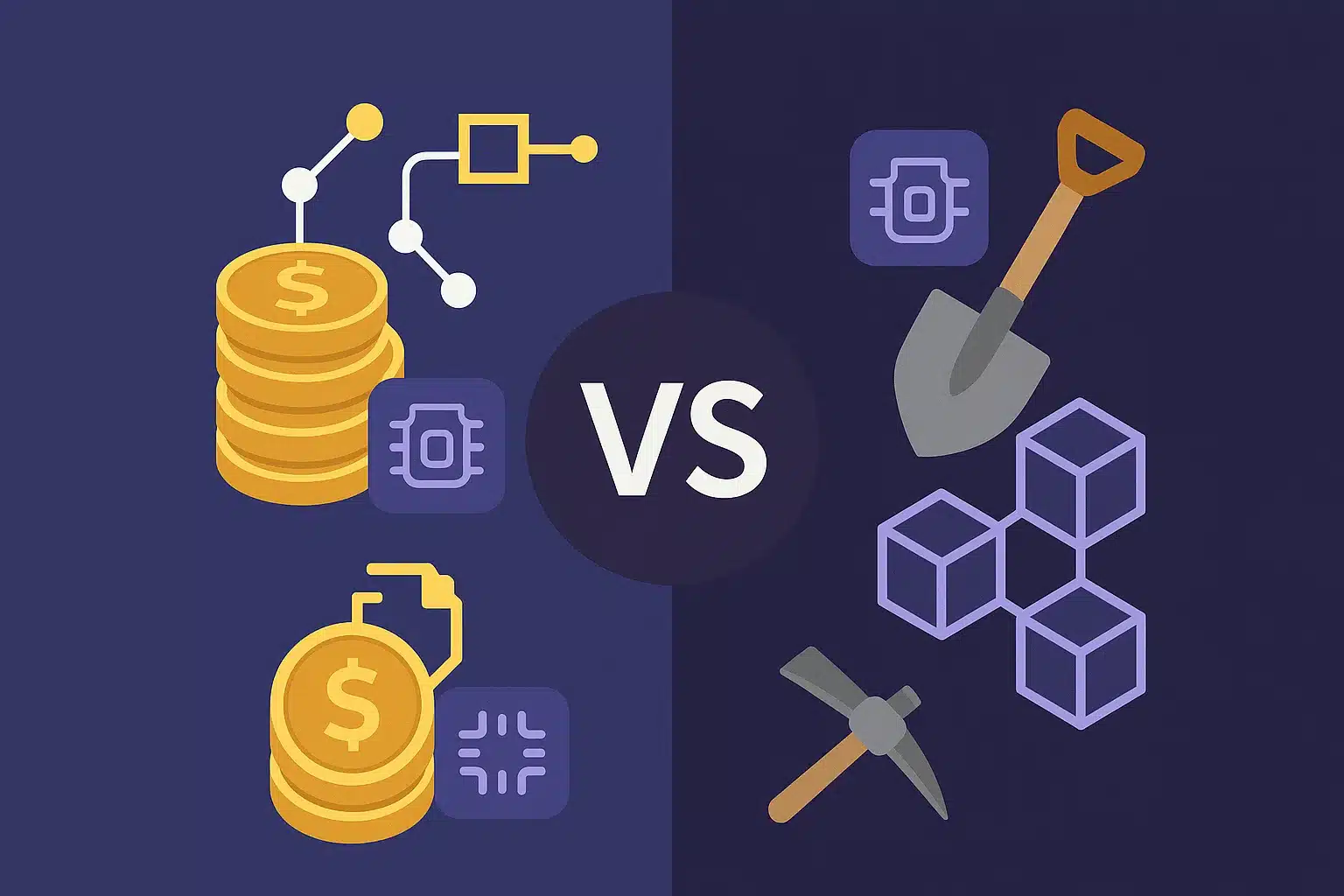
The rise of cryptocurrencies has brought with it new ways of securing digital money. At the heart of blockchain technology are consensus mechanisms, the methods by which decentralised networks agree on the state of transactions. Two models dominate the conversation: Proof-of-Work (PoW) and Proof-of-Stake (PoS).
Both are designed to achieve the same goal, ensuring that only valid transactions are added to a blockchain. But they approach the problem in fundamentally different ways. Understanding the distinction is crucial for anyone looking to grasp how Bitcoin, Ethereum, and other cryptocurrencies function.
What Is Proof-of-Work?
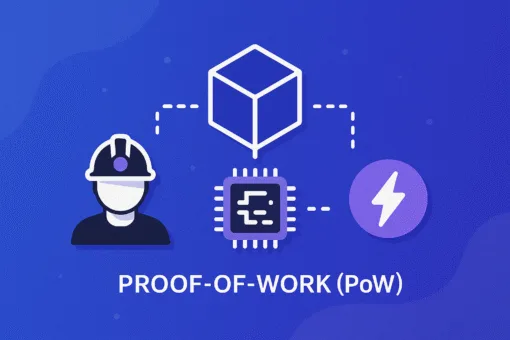
Proof-of-Work was the original consensus mechanism used in blockchain. Introduced with Bitcoin in 2009, it relies on computational power to validate transactions. Miners compete to solve complex mathematical puzzles, and the first to solve it earns the right to add a new block to the chain. In return, they receive newly minted cryptocurrency and transaction fees.
The process is secure because solving these puzzles requires vast amounts of computing power, making it prohibitively expensive for malicious actors to attack the network. To alter a block, one would need to control more than 50 percent of the network’s total computational power, a scenario known as a 51 percent attack.
While Proof-of-Work has proven resilient, it comes with high energy costs and scalability limitations. These drawbacks have fueled the search for alternatives.
What Is Proof-of-Stake?

Proof-of-Stake emerged as a response to the inefficiencies of Proof-of-Work. Instead of relying on raw computational power, PoS secures networks by requiring validators to lock up, or “stake,” their cryptocurrency as collateral. Validators are chosen to propose and validate blocks based on the size of their stake and, in some implementations, randomness.
If validators act dishonestly, they can lose part of their stake, creating strong incentives for honesty. PoS eliminates the energy-intensive mining process and can support faster, more scalable blockchains.
Ethereum’s transition from Proof-of-Work to Proof-of-Stake in 2022, known as “the Merge,” marked one of the most significant shifts in blockchain history. It reduced the network’s energy consumption by more than 99 percent, setting a precedent for the industry.
Strengths of Proof-of-Work
- Proven security: PoW has been tested for more than a decade, securing Bitcoin’s trillion-dollar ecosystem.
- Simplicity of design: The mechanism is relatively straightforward to understand and implement.
- High cost of attack: The enormous energy and hardware requirements make attacks impractical for large networks.
These features make Proof-of-Work a trusted model, especially for Bitcoin, which prioritises security and decentralisation above all else.
Weaknesses of Proof-of-Work
Despite its strengths, PoW faces criticism:
- Energy consumption: Mining consumes massive amounts of electricity, raising environmental concerns.
- Hardware centralisation: Mining tends to concentrate in regions with cheap electricity and specialised hardware, reducing decentralisation.
- Limited scalability: Block times and transaction throughput are constrained, making PoW slower compared to newer systems.
These issues explain why many newer blockchains are turning to Proof-of-Stake.
Strengths of Proof-of-Stake
- Energy efficiency: PoS consumes far less power since it eliminates mining.
- Scalability: PoS supports faster block times and higher throughput, enabling more complex applications.
- Lower entry barriers: Validators do not need expensive hardware, only tokens to stake.
- Flexibility: Variants of PoS allow experimentation with incentives and governance.
For platforms like Ethereum, Cardano, and Solana, these strengths are essential for supporting decentralised finance (DeFi), NFTs, and other high-volume use cases.
Weaknesses of Proof-of-Stake

- Wealth concentration: Those with more tokens have more influence, raising concerns of centralisation.
- Complexity: PoS mechanisms can be more complicated to design and audit, increasing risk of bugs.
- Newer track record: PoS is younger and less battle-tested compared to PoW.
- Slashing risks: Validators may lose staked tokens for mistakes or malicious behavior, creating added risk for participants.
While promising, Proof-of-Stake must continue to prove its long-term resilience.
| Feature | Proof-of-Work (PoW) | Proof-of-Stake (PoS) |
|---|---|---|
| Security Basis | Computational power | Economic stake |
| Resource Use | Energy-intensive | Capital-intensive |
| Hardware | ASICs, GPUs | Standard servers |
| Entry Barrier | Hardware + cheap energy | Owning tokens |
| Environmental Impact | High | Low |
| Long-Term Viability | Proven, but energy concerns | Scalable, newer model |
Environmental Debate
One of the most significant debates between PoW and PoS centers on sustainability. Critics argue PoW’s energy consumption is unsustainable, comparing it to the electricity usage of entire countries. Supporters counter that much mining now uses renewable energy and that the security trade-off is worth it.
PoS largely sidesteps this debate, consuming minimal energy. This distinction was central to Ethereum’s decision to migrate to PoS, aligning with global sustainability goals.
Decentralisation Concerns

Decentralisation is another key battleground. PoW risks centralisation through mining pools, where a few large players dominate the network. PoS risks centralisation by concentrating power among the wealthiest token holders.
The balance between decentralisation, efficiency, and security is delicate. Neither mechanism perfectly solves it, but each represents a trade-off shaped by different priorities.
Use Cases and Adoption
- Proof-of-Work: Best suited for cryptocurrencies prioritising security and resistance to censorship. Bitcoin remains the prime example. Litecoin and Monero also rely on PoW.
- Proof-of-Stake: More suited for scalable ecosystems that require high throughput. Ethereum, Cardano, Solana, Polkadot, and Tezos all use PoS or variations of it.
As crypto matures, different consensus models may coexist, serving different purposes.
Future Outlook: Two Paths to the Same Goal
The future of consensus may involve hybrids or entirely new approaches. Some blockchains combine Proof-of-Work with Proof-of-Stake or introduce delegated staking to balance efficiency with decentralisation.
What is clear is that PoS will dominate new blockchain launches due to scalability and sustainability. However, PoW is unlikely to disappear. Bitcoin’s status as digital gold depends on its proven PoW security, and its community strongly resists change.
The conversation is no longer about which is better, but about how different mechanisms can coexist in a diverse crypto ecosystem.
Proof-of-Work and Proof-of-Stake aim to achieve the same outcome: secure, decentralised, and reliable blockchain systems. PoW achieves this with computational power, while PoS does it with economic incentives. Both have strengths and weaknesses, and both will likely continue to play roles in the crypto landscape.
For consumers and investors, the key is understanding how these mechanisms impact security, energy use, and decentralisation. In a future where blockchains underpin global finance, the choice of consensus model will shape not only the technology but also the trust people place in it.