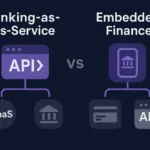

Financial services are increasingly becoming invisible. Payments, lending, insurance, compliance, and treasury functions no longer appear as standalone products. Instead, they are embedded directly into software platforms, marketplaces, and operational tools. This shift is being driven by a deeper structural change, the rise of Financial Infrastructure-as-a-Service.
Financial Infrastructure-as-a-Service is not simply another fintech category. It represents a fundamental redesign of how financial capabilities are built, distributed, and consumed. Embedded finance is the visible layer. Financial Infrastructure-as-a-Service is the foundation beneath it.
This article examines how Financial Infrastructure-as-a-Service enables embedded finance, why it matters strategically, and how it is reshaping the economics and structure of modern financial services.
Understanding Financial Infrastructure-as-a-Service
Financial Infrastructure-as-a-Service refers to the delivery of core financial capabilities as modular, programmable services. These capabilities are accessed through APIs, SDKs, and configurable workflows rather than delivered as finished consumer products.
Instead of building a bank, payments processor, or compliance operation, companies integrate financial functions directly into their own products. Account creation, payments, card issuing, lending, identity verification, and reporting are consumed as infrastructure.
The concept mirrors cloud computing. Just as businesses no longer build data centres, they no longer need to build regulated financial operations to offer financial features. Financial Infrastructure-as-a-Service abstracts complexity and exposes only what product teams need.
The shift from financial products to financial building blocks

Traditional financial services were designed as end products. Customers opened bank accounts, applied for loans, and purchased insurance policies as discrete actions. The financial institution owned the relationship, the data, and the distribution.
Financial Infrastructure-as-a-Service reverses this model. Financial functionality becomes a set of building blocks that software companies assemble around their users’ workflows. Finance adapts to the product experience rather than dictating it.
This shift allows non-financial companies to become the primary interface for financial activity. Marketplaces, SaaS platforms, and vertical software providers can integrate finance seamlessly without positioning themselves as banks.
Embedded finance is the outcome of this shift. The infrastructure itself remains largely invisible to the end user.
What Financial Infrastructure-as-a-Service actually includes
Financial Infrastructure-as-a-Service is broader than payments APIs or Banking-as-a-Service alone. It covers a full stack of regulated and operational capabilities.
Typical components include account creation and management, domestic and cross-border payments, card issuing and acquiring, lending and credit decisioning, identity and KYC workflows, AML monitoring, reconciliation, reporting, and regulatory support.
Providers focus on abstraction and reliability. They manage bank partnerships, regulatory changes, and operational processes behind the scenes. Software platforms interact with consistent interfaces rather than fragmented financial systems.
Examples include payments infrastructure from Stripe, global acquiring and issuing from Adyen, Banking-as-a-Service layers from Solaris, and embedded finance platforms such as Unit. Each operates at a different layer, but all deliver financial capability as infrastructure.
Why embedded finance depends on infrastructure first

Embedded finance is often explained through use cases. Buy now pay later at checkout. Instant payouts for gig workers. Lending inside accounting software. Insurance bundled into a booking flow.
These experiences are compelling, but they are not the primary innovation. The real change lies in the separation of financial capability from financial brands.
Without Financial Infrastructure-as-a-Service, embedded finance is slow, expensive, and difficult to scale. Building regulated operations requires licences, compliance teams, and banking relationships. Infrastructure providers absorb this complexity.
Platforms can then focus on user experience, data, and distribution. This is what allows embedded finance to scale across industries rather than remain confined to fintech specialists.
The economic logic of Financial Infrastructure-as-a-Service
Financial Infrastructure-as-a-Service reshapes value creation in financial services. Traditional banks monetise balance sheets and direct customer relationships. Infrastructure providers monetise volume, integration depth, and long-term platform dependence.
For software platforms, embedded finance creates new revenue streams. Payments generate transaction fees. Lending produces interest income or referral revenue. Financial data strengthens retention and pricing power.
For infrastructure providers, the model combines enterprise software economics with financial margins. Marginal costs decline as volume increases. Switching costs rise as platforms embed infrastructure deeply into their operations.
This creates strong network effects. More platforms lead to more volume. More volume improves pricing and reliability. Better infrastructure attracts more platforms.
Embedded finance across industries

Embedded finance has expanded well beyond fintech-native platforms. It is now present across a wide range of industries.
E-commerce and marketplaces integrate payments, seller financing, and instant payouts. Logistics and mobility platforms offer embedded wallets, fuel cards, and real-time earnings access. B2B SaaS platforms embed invoicing, credit, and expense management.
Healthcare platforms integrate treatment financing. Property platforms embed rent collection and insurance. Education platforms offer tuition financing and subscriptions.
In most cases, users do not perceive a financial provider at all. The platform brand owns the experience. Financial Infrastructure-as-a-Service operates entirely in the background.
This invisibility is intentional. The less friction users experience, the more valuable embedded finance becomes.
Regulation, risk, and shared responsibility
Financial Infrastructure-as-a-Service does not remove regulation. It redistributes responsibility.
Infrastructure providers remain regulated entities or partners of regulated banks. Platforms operate under programme agreements and defined controls. Compliance is shared, not eliminated.
This creates governance challenges. Platforms must understand what they can customise and where constraints apply. Infrastructure providers must balance compliance with speed. Regulators must adapt to fragmented value chains where customer experience and financial operations are separated.
Risk management also changes. Fraud, credit risk, and operational failures can propagate across platforms if not carefully managed. As a result, infrastructure providers increasingly offer monitoring, controls, and risk tooling as part of the service.
Competition and consolidation in the infrastructure layer

The Financial Infrastructure-as-a-Service market is highly competitive and increasingly consolidating. Scale matters. Broad geographic coverage, regulatory licences, and payment methods create strong advantages.
Larger providers expand horizontally by adding new financial primitives. Smaller providers specialise deeply in areas such as lending, identity, or cross-border payments.
Traditional banks face difficult choices. Some partner with infrastructure providers. Others build API layers internally. Few can match the speed, modularity, and developer focus of infrastructure-native firms.
Over time, the market is likely to resemble cloud infrastructure. A small number of global platforms surrounded by specialised and regional players.
Strategic implications for founders and platforms
For founders and platform leaders, Financial Infrastructure-as-a-Service is a strategic decision rather than a technical one.
Embedding finance can increase lifetime value, reduce churn, and create durable differentiation. It can also introduce operational dependency, regulatory exposure, and complexity.
Successful platforms treat embedded finance as a core capability. They design financial flows around real user needs and understand unit economics and risk allocation. They choose infrastructure partners with long-term alignment rather than short-term pricing advantages.
Financial Infrastructure-as-a-Service allows platforms to act like financial companies without becoming banks. That distinction underpins the scalability of the model.
The future of Financial Infrastructure-as-a-Service
Financial Infrastructure-as-a-Service continues to evolve. Infrastructure is becoming more composable, allowing platforms to combine multiple providers. Data is becoming more central, with analytics and optimisation layered into infrastructure services. Global expansion is accelerating as platforms demand cross-border capabilities.
AI will enhance risk assessment, fraud detection, and personalisation, but it will complement rather than replace infrastructure.
As finance continues to dissolve into everyday digital experiences, Financial Infrastructure-as-a-Service will define who controls distribution, economics, and innovation. Embedded finance is only the surface. The infrastructure beneath it is where the future of financial services is being built.